Four feel-good hormones to happy

Four feel-good hormones to happy

Feeling low? Feeling anxious? Caught up in looping thoughts, none of which make you glad to be here right now?

We may know the answer to our misery is to get out and ‘move it’, but our mind is set on ‘meh’.

Our bodies are designed to move, leap, bound about and live – with a capital L. 

Unfortunately, depression and anxiety prefer the opposite. Sitting in, on the sofa, wrapped in a duvet, consuming ice cream/crisps/haribo (pick your poison, or combination) like it’s going out of fashion, caught up in our own fears, unable to sleep properly… Couch to 5k may as well be Couch to Mars…

So where to start? Certainly a Rapid Transformational Therapy (RTT) session on taking action is ideal for getting you out the door, blinking into the daylight, and shaking your backside with an enthusiasm you can scarcely recall.

Out there you’ll find four friends, who haven’t been coming around for a while. They are:

  • Dopamine
  • Endorphins
  • Serotonin
  • Oxytocin.

These four guys are like the four musketeers – they’re all for one and one for you. They are the ‘feel good’ hormones. Want to feel better? Go find them. And the best way to create feel good hormones? Make your own. Naturally.

Dopamine

Here is probably the easiest start. Top up your dopamine to the brim. Dopamine is the neurotransmitter that helps control the pleasure and reward centres in our brains.

  1. Laugh. Put on your favourite funny DVD, rewatch comedy classics, listen to comedians until you weep with laughter. Laughter is a well-researched pain killer which is also said to stimulate regions of the brain that trigger dopamine. For me, Laurel and Hardy’s Laughing Gravy lifts the darkest mood. And it’s got the cutest dog. The cutest dog that ever lived. Don’t believe me? Watch it. I dare you not to laugh.
  2. Set goals. Easy ones. Like getting off the sofa and having a shower. Celebrate this achievement. Seriously. It’s the striving to achieve that triggers the dopamine. Set goals you can meet and cheer yourself on. Dopamine rising. Yes; go you!
  3. Massage. Lowering stress hormones and creating dopamine, massage is a worthwhile investment, because it also stimulates your next best friend – serotonin.

Serotonin

OK, we’re going to have to leave the sofa now, but serotonin is worth the effort. You’ll get: better sleep, your appetite should normalise and this mood-improving hormone can help you feel that elusive of moods – happy. Want happy? Step outside because…

  1. Sunlight is one of the best sources of vitamin D and serotonin needs this vitamin to synthesise. This is just one of the reasons why the winter months feel so gloomy (that and the cold and the wind and the rain and the central heating sucking the air dry and… I’m not a winter fan) but you don’t need a lot of daylight, just enough to feel the sunlight on your face and forearms (if you can bear to roll up your sleeves).
  2. Walking – daily exercise boosts this hormone and just a brisk walk will do wonders. Remember; goals met boost dopamine, so let’s get out and cheer ourselves on.
  3. Foods that are rich in tryptophan are said to be good for boosting serotonin. These include: eggs, pineapple, tofu, salmon, nuts and seeds, plus turkey.

Endorphins

These are the anxiety-busters with painkilling power and a calming effect. What’s not to like? Here’s how you wake them up.

  1. Exercise – doesn’t need to be full pelt, a 30-minute walk is going to help, but…
  2. Sweat, even if you slip straight into the sauna or steam room, is going to trigger the production of endorphins as stress melts from your muscles
  3. Chillis are a welcome addition to meals if you enjoy spice as once capsicum hits your tongue it sends a signal to the brain that’s similar to a pain signal, triggering endorphins

Oxytocin

If ‘love is the drug’ oxytocin is certainly the hormone at play. It’s stimulated by intimacy and that can be through:

  1. Massage. Yes, up again as a top feel good hormone starter tool. Along with serotonin and dopamine, oxytocin is stimulated by massage.
  2. Hugs. Research reports differ on how many we need to feel tip-top but it’s certainly more than two daily and as many as12 if you want to thrive, according to family therapist, Virginia Satir.
  3. Pets really do make us feel better. Cuddling up with your cat or playing with a dog can improve oxytocin levels.

Starting to get overwhelm? If this is looking like a lot of effort you don’t have, think multitask: deciding you’re going to make a start and celebrating your decision to take action, taking a 30 minute brisk walk in daylight and stopping to pet friendly looking dogs, and you’re working on all four. Eggs for breakfast, hug your nearest and dearest when you greet them and get a massage once a month… these are all going to help you heal you.

Because here’s the truth: you are your own rescue. I can help you take those steps but you are the one who takes action. And that is, ultimately, the most empowering thing I can tell you.

You are your own rescue. You have the power.

Building emotional muscle

Building emotional muscle

‘My tongue shall tell the anger of my heart. Or else, my heart, concealing it, will break.’ William Shakespeare

Saying how we feel can be about as easy as speaking a strange, foreign language.

We might have only ever learned a few words of this language. Perhaps we have always struggled with its pronunciation. Or maybe we once spoke it well, but events shocked us into silence.

And so we’ve lost our fluency.

According to research professor Brene Brown, who has spent the past sixteen years studying courage, vulnerability, shame, and empathy, there are 30 core emotions. That’s right, 30. Does that feel like a lot?

As children, our emotional vocabulary is more basic. As a therapist who uses hypnosis as a tool to trace clients’ issues back to where they began, I frequently hear clients describe their feelings in the language of children.

‘I feel scared..’, ‘I feel sad…’, ‘I feel happy…’

Connecting with our emotions and recognising them for what they are – flags to encourage us to take action – makes for a much happier existence. There are no ‘bad’ emotions. They are all designed to prompt us into action.

But if we pretend we haven’t seen the flag, it gets bigger and louder and waves in our face more and more frequently. And that can start to affect our lives in adverse ways.

The Core 30

30CoreEmotions

Do you recognise all 30?

Becoming fluent in your emotions is a skill.

Some of these emotions feel very different from each other. For example, I think we’d all agree ‘joy’ feels very different from ‘grief’. Joy feels light, bright, giddy… when I think of joy I see the colour ‘gold’. ‘Grief’ feels dark, heavy, slow… a murky, muddy colour. But that’s just me; everyone sees and feels something a little different. I feel joy high in my chest, grief deep inside my heart.

But what about ‘fear’ and ‘excitement’? We feel both these emotions start in our stomach. That nervous fluttering feeling – is that rising excitement or the first signs of terror? Can you tell? Yet they are very different emotions. And this is perhaps why some of us love flying and others loathe it; why I laugh at classic horror films and find them thrilling, while others think they’re horrible and pointless.

Recognising the difference can take a while. Take your time. Remember; they’re just flags.

Say how you feel

Saying how you feel is the next skill. And the 3 As will help you through.

Emotions aren’t always rational. They’re not meant to be, they’re emotions not quadratic equations. But go exploring and you’ll improve your wellbeing.

So how do keep your emotional wellbeing in top condition?

The 3As: Aware. Accept. Articulate

  1. Be aware of the feeling appearing – whatever it is.
  2. Accept it. The emotion may not make sense. You may be jealous of a friend’s new job. You know, rationally, her success does not detract from you at all. You may not even want her new job. It may be the last job in the world you might want, but something is going on.
  3. Articulate the emotion. Don’t swallow it down as negative. It’s not negative – it’s a message to take action. Tell a friend, or your partner or ask yourself what’s going on with you.

Speaking your truth

Building emotional fluency takes practice. And bravery. Remember sitting in class and having to speak another language? You struggled to form the words. You were scared the other kids were going to laugh at you. But this isn’t French class. You’re a grown up now (or a very bright, persistent kid, because you’ve ploughed through a lot of ideas to get here). Close your eyes. Breathe in, breathe out. Hear your emotion.

What if you get it wrong? So what? You’re learning a language. Building emotional muscles. You’ll be the Rocky of emotional fluency before you know it.

And your emotional wellbeing will thank you.

5 reasons why yoga brings more profit to your business

5 reasons why yoga brings more profit to your business

What does lunchtime look like where you are?

A refreshing walk in the park with your work best-friends? 

Maybe you’re juggling the job and family so for you it’s (yet another) quick dash around the supermarket, grabbing everything you need to keep the home life together? 

Or is it this… Another uninspiring sandwich, eaten el desko as you plough on with your spreadsheets and emails between bites?

If you work in a small team or you’re a solo operator, pounding the keyboard at home, it’s very easy to prioritise everything but what’s screaming out for your attention.

Can’t hear it? No? Let me ask you this…

Got any niggling aches and pains? Do you find you’re flagging as the day progresses? Reaching for snacks and caffeine to push you through the work?

That’s the screaming. Your body’s screaming ‘Owwwwwwwwwwwwwwwwww!’ And probably swearing it’s backside off too.

So, no – another headache pill and another shot of coffee is not the answer. Not when your mind, body and soul needs nourishing.

Yoga: the stress buster supremo
Yoga cuts through stress like a knife through butter and stress costs your business – a lot. Have you considered how many days productivity you’ve lost to stress? And if you’re a solo operator like me then you know how valuable your health is – losing time is one thing, being ill is not going to help our profit margins.

One of the world’s biggest health insurance companies, Aetna Inc, worked with a university to measure employee stress and evaluate a corporate yoga programme they introduced at the company. Employees taking part showed a 33% reduction in stress levels in just 12 weeks. If stress is costing your business; yoga is a great investment, not a luxury.

Yoga: mindset booster
Yogic philosophy has an assortment of highly effective weapons for battling though any day. Like mind martial arts. The art of ‘non attachment’ changes your life like no other when it comes to getting along with coworkers. Once we can separate our emotions from our actions life gets a lot easier.

Yoga: instant energy
Want to change how you feel. With yoga. Right now. In just 2.5 minutes? Try this.

Set your phone timer to let you know when 2 minutes are up.

Stand with your feet apart. Hands on your hips. Chest lifted. A slight smile on your lips.

Close your eyes.

Feel the energy flowing up from the ground. Sense your spine lengthening as the energy surges up.

Imagine your cape, your wonder woman or superman cape, fluttering in the breeze behind you.

Breathe in deep.Breathe out deeper.

When the timer rings, throw your arms up into the air – like you’re celebrating Olympic gold. Hold your arms up there for 10 breaths.

Feel free to shout ‘YES’ if you want to.

How do you feel now? Better? That power posing exercise – viramudra to jayamudra, if you want the yoga terms for that– is a very quick way to shift your psychology through your physiology. Imagine what a weekly class could gift you.

Yoga: the office painkiller
We all know sitting is ‘the new smoking’ and our desk bound lives are doing us no good. At all. But  as well as giving you great tips for yoga at your desk, the strength and muscle work developed through a physical yoga practice, together with improved posture, makes our lives more comfortable.

Yoga: the focus sharpener
Mindfulness is an amazing tool for helping us get through all those annoying jobs we purposely ignore in favour of the ones we prefer. Turn the dull jobs into a mindfulness exercise and the joy can start to reveal itself.And, being completely present, you make fewer mistakes. Saving more time. Hurrah.

I could go on, but here’s the bottom line. Yoga saves you money, makes you happy, stronger and more effective, your team more effective and so your profit margins more effective.

All you need is space for a yoga mats, a dance studio space is not required. 

I teach corporate yoga in the Eastbourne area of the UK, but every town has one, if not more. What have you got to lose? Except maybe your back ache.

Eight ways to beat burnout

Eight ways to beat burnout

‘We’re so engaged in doing things to achieve purposes of outer value that we forget that the inner value – the rapture that is associated with being alive – is what it is all about.’ – Jospeh Campbell

On the flip side of burnout out is a radical idea that challenges the very fabric of current cultural norms. Balanced living.

Sounds so simple, doesn’t it?

Yet the art of living a balanced life is not easy. It’s actually extraordinarily challenging. I Dare You, is the title of  the William H Danforth book that lays out this recipe for living.

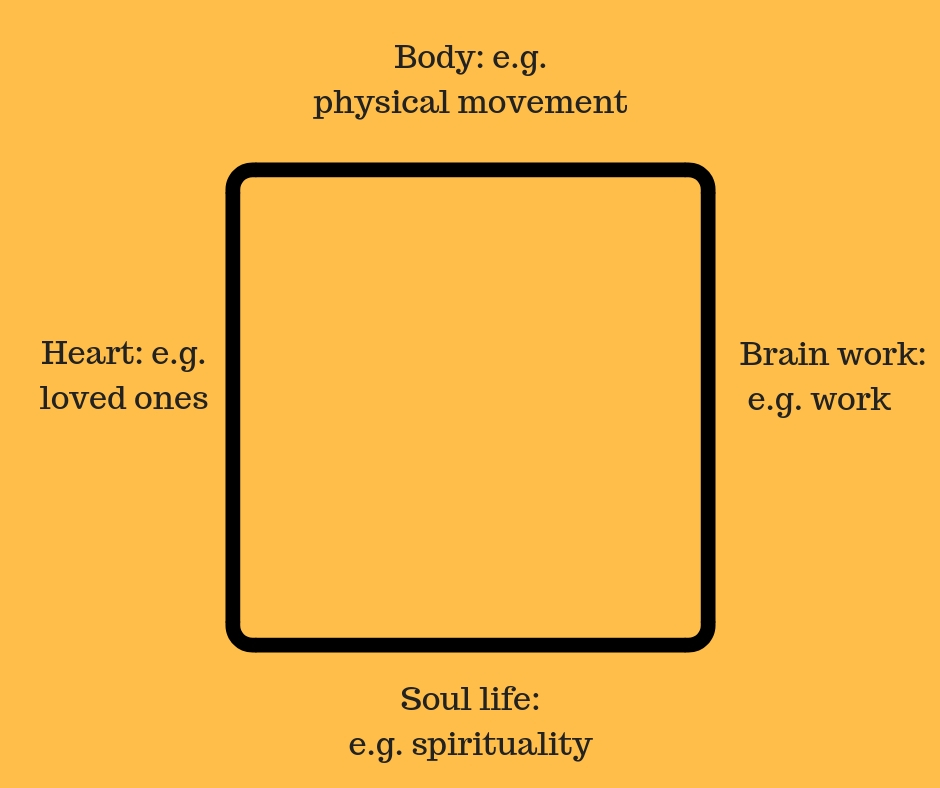
First published in the 1930s, Danforth’s slim manifesto advocates the idea that each person has not one, but four lives to live: physical, mental, social and spiritual. The ingredients for life are a body, a brain, a heart and a soul, he would say. All four must grow in balance with each other.

Or what? Or else? I’m a questioner with a rebel streak who will poke about researching the life out of anything before it gets house room. But this idea makes absolute sense, even to deeply suspicious little old me.

Let’s look at the reality of life today.

We live in a world that highly values work. It’s gone beyond cult status. And I’m not saying work isn’t important, but how did it come to be the be-all-and-end-all in our lives? 

The industrial revolution changed the way we lived and prompted literature reflecting deep concerns for social wellbeing, from HG Wells to William Morris. But the social media revolution seems to have created fewer ripples of concern as the internet’s globalisation rips down old barriers of time zone or place. Maybe we’ve just got used to work obsessing in the century that has passed since News from Nowhere and The Time Machine were published.

We may point to books like the Four Hour Work Week, but who do you know who lives that life? Has the internet really freed us to live more – or do more? The Devil Wears Prada is as relevant today as it was 12 years ago. Probably more so because advances in tech mean we can have meetings and file share anytime and anyplace (with reliable wifi).

We are trained to value work beyond our body, beyond our Self, beyond love. Otherwise, how would all that work get done? Our ‘things’ based culture would collapse. Instagram would rustle to the sound of tumbleweed. Who would make everything? Who would buy everything? Who would ‘like’ everything?

Our world relies on our commitment to shackling our time to our work. And when we see our work as a vocation, then we are especially vulnerable to burnout. Because we’re trying to make the world better for others.

I know. I’ve done it. More than once.

According to Danforth, a balanced life looks like this…

SquareofBalance

Mine used to look more like this.

Work-2

That rush that comes from doing more, achieving more, pushing further, giving more, receiving more… it is highly addictive. I used to suffer from the ‘disease to please’. Not any more. I now know myself. And my value.

Burnout is a hideous experience. Being stressed is bad enough; burnout is the inevitable crash of too many hours at the desk, too few laughing with friends, meditating in whatever activity inspires your connection with your soul Self and caring for your body in a nurturing, loving way.

Burnout has its own trinity: physical, mental and nervous exhaustion. Its symptoms can include uncontrollable emotional outbursts, disordered eating, drinking too much, poor sleep, foggy brain and thoughts of suicide are not uncommon.

If the thought ‘I know it’s not a solution, but dying right now, seems attractive’ bobs by, then it’s time to take action. Now. Nothing is that bad. Those thoughts are a big red flag, waving at you, telling you to recalibrate. Rebalance. Change. They are not an instruction, they are a flag. See the flag.

Why you are so vulnerable to burnout, likely lies in your past. Getting a deep understanding of why past events are no longer relevant to you is a key part of ensuring burnout never happens again. Rapid Transformational Therapy (RTT) is one way to very quickly get a deep understanding of where these behaviours originate and exactly why they are no longer relevant to your present. But other brands are available, as they say, and the counselling root is one. Psychotherapy  is another.

There are, of course, practical steps  to take which keep our four lives in balance with Danforth’s model.Here are eight habits to cultivate and enjoy.

Eight tips for Avoiding Burnout

Eat well
Good nutrition not only feeds your body, it feeds your brain. When you’re stressed your brain is flooded with the stress hormone, cortisol. It does not need buckets of caffeine mixed in with that. It does not need gallons of sugar. Stressed, wired and sugar-rushing is not going to make anything better. Your inner voice may be screaming for them, because you’re exhausted and miserable, but fresh vegetables, fruits, proteins and lots of water are the way. At least 80% of the time. (I may be a questioning rebel, but I’m also a realist).

Exercise
Exercise can be as effective a treatment for depression as drugs. That is why time, every day, should be devoted to it. Walk, every day. Dance. Go to yoga. Walk to yoga. Do a sport or physical pastime that you enjoy and mix it up. Focus on having fun. If you need a personal trainer to chase you then get one, but make sure you’re not choosing another person to bully you – look for someone who makes you feel good about yourself.

Love
Loving ourselves can be one of the hardest journeys we embark on, but also one of the most rewarding. Spend time being present with yourself in ways that nurture you. Be present with others and nurture them. Let in their love. Friends, family, lovers, pets, your community… get in there.

Laugh
Laughter really is an incredible medicine. Watch funny films. Hang out with funny people. Go to comedy clubs. Laughter cuts down stress, can numb physical pain and aid learning ability! Laughter yoga is a real thing – chuckling, guffawing, snorting belly laughs work wonders.

Meditate
Start with just 5 minutes a day. Everyone has 5 minutes.Set the timer on your phone and just go for it. There are a gazillion guided meditations out there and many, many apps. Just try it. It’s like learning to draw. It’s frustrating, but persistence will repay you a thousand fold. 

Have faith
If you have a spiritual practice, giving time to connecting with it is hugely nurturing for the mind and body. If you don’t and prayer feels alien to you, mantra can be extraordinarily calming. It brings the same calm, talking the mind away from its incessant chatter and towards nurturing thoughts. Mantra is a key part of yoga mediation and brings a deep connection to the breath, which, in turn fuels and calms the body and nervous system in other ways. Try the phrase ‘I Am Enough’. Very simple. Easy to take on board. Highly effective, if applied frequently.

Prioritise sleep
Exercising and eating well will help you sleep better. Turn your bedroom into a sleep haven. It should not resemble your living room. No TVs, laptops or mobile phones in the bedroom. I know, but all that light going to mess up your ability to fall asleep and stay asleep.

Watch less TV
Let go of the Netflix and wine before bedtime. Play cards, go for a walk, read books, play chess. Do the mind tasks that don’t involve passively staring at a screen will not only help your mind step away from the day, it strengthens the brain and has been shown to be effective in treating brain fog. So stop watching soaps and start doing sudokus. No laptop. No mobile. Leave the screen alone.

If you recognise any of the symptoms of burnout I describe in this post and would like help getting back to balance, do get in touch.


Power to heal is yours

Power to heal is yours

‘Strength does not come from physical capacity. It comes from an indomitable will.’

Mahatma Gandhi


Occasionally in my line of work you are asked to help people you know. That’s both pressure and a blessing.

I trained with Lillieth, on the Rapid Transformational Therapy (RTT) Advanced Practitioner course. She does great, meaningful work as a children and mothers’ therapist.

When Lillieth was hit by crippling headaches while on holiday in the USA, she thought she was having another migraine. But the pain just got worse.

What transpired was she’d had a brain haemorrhage, which had left a blood clot in her brain. Hospital followed. So much fear and uncertainty, and then Lillieth had to wait for medical permissions to fly home. Back home in Holland, recovering, she was left with a weakened right side and her speech was affected. Her doctor advised her to prepare for a long recovery period..

I coached Lillieth via skype and gave her a bespoke, RTT hypnotherapy recording to aid her body’s recovery process. She immediately felt and saw results. She continued to listen to her recording at least daily and beyond the minimum 21 days we usually advise to embed a habit.

When she made this testimonial for me, just weeks after her getting back home, Lillieth says her speech is almost 96% back, her body strength is returning.

Her doctor thought Lillieth wouldn’t be working for a year. She’s already back helping mothers and children, doing the job she loves.

I spoke to her again in September. She looks really well. She’s full of life and love for her future, planning her first speaking engagement – in front of 150 people in October!

This transformation is not just my input. Lillieth was right there. Doing the work, listening to the recording, developing the ‘I can, I will’ mindset that has seen her through this trauma.

Therapists do not have magic wands. Recovery is a two-way process. We light the way with everything we have, but it’s the client’s journey. When the client works with the therapist, steps forward and puts whatever energy they can find into getting up and moving on, then it feels like transformational miracles can happen.

From ‘crippling perfectionism’ to ease and flow

From ‘crippling perfectionism’ to ease and flow

Suddenly my procrastination and crippling perfectionism is gone, my relationship with my body is relaxed and loving, I have much more acceptance for my own and other people’s flaws and I am constantly productive. Unless I’m resting: which I now do often and sans guilt.
Mrs C, international businesswoman


I’ve been recently working with clients around the area of Confidence. It’s curious how clients come in clusters, but also useful, because you learn from people’s different experiences in a way that helps you see patterns very quickly.

This is quite detailed feedback from an amazing professional woman who is focused on being all that she can be. It was an absolute pleasure to help her shift from procrastination and self-doubt into a state of ease and ‘flow’.

Because she is well known in her field, she was keen to remain anonymous; client confidentiality is always respected by therapists so that’s why she’s not named. However, this is published with her blessing.

I meet many swans, frantically paddling through life, desperately pretending to glide. I’ve been one. If this rings bells for you; know that change is possible and you have the answers locked with you. You just need the key.

What is so special about Rapid Transformational Therapy (RTT) is the way it uses hypnosis to help the client get right into their subconscious and the roots of their issue. One to three sessions are usually all you need. And for a busy swan, that’s a big bonus.


Testimonial from Mrs C, a business consultant
working across Europe

The Issue

I felt particularly vulnerable after a period of three massive personal challenges that I have had to overcome, one after the other. It felt like this has influenced my professional life: I was losing confidence in my abilities. 

Even though I was in the best possible place professionally – I was doing the exact thing I always dreamed of doing and I was aware that I was not particularly bad at it either – I was struggling whenever I tried to convince someone to hire me. Rationally I was quite certain that the client could benefit from my work, but silently I was doubting myself and it was crushing me.

Conventional therapy has helped me overcome most of my issues – at least the ones that I was aware of. However, this lack of confidence had surprised me, and I did not know how to approach it. It seemed like hypnotherapy might be something to try, even though I secretly harboured doubts about its powers.

But after the initial session I realised there were events in my remote past that have shaped me in unexpected ways. These little events, seemingly not at all relevant, have produced tidal waves of emotion. While I was unaware of their source, they were quietly sabotaging me in my daily professional life.

The Experience

It felt like someone had opened the door to a completely new part of me, where memories, emotions and rationalisations live beyond my control and awareness. 

However, even though it has been shocking in a way, it was utterly pleasant. But mostly it brought a big sigh of relief that comes with finally understanding why I sometimes feel things I can’t explain rationally.

I have been through conventional therapy very successfully, I have educated myself and I have found my focus in life. However, hypnotherapy showed me that I only think I understand myself. I think that until you manage the courage to peek into your subconscious, you have not really understood your motivations. 

Deana is an extremely gentle therapist. I think she understands that the revelations her clients are met with during her sessions can be a little shocking, so she takes extra care to make you feel safe and accepted. Also, she makes you feel like this struggle you are facing is now your joint obstacle: you will tackle it together. She helps her clients climb those barricades they have built for themselves and then she checks on them to see how they are doing once they are on their own path. 

The outcomes: what’s changed

It’s funny how difficult it is to explain this. I was hoping for more confidence and absence of doubt in myself professionally. What I got was this hard-to-describe feeling that there is no need to try this hard, because as long as you live your best life, everything you do is good enough.

Suddenly my procrastination and crippling perfectionism is gone, my relationship with my body is relaxed and loving, I have much more acceptance for my own and other people’s flaws and I am constantly productive. Unless I’m resting: which I now do often and sans guilt.

I think it is safe to say that I have been more genuinely productive since my hypnotherapy session than I have been in the last 20 years.

I am not denying that I was quite productive before, too, but it was always with a sense of having to push through. Always, I felt like I was climbing a very steep mountain. Everything felt like a chore, even the simple things. I wanted to do the work, but at the same time I somehow did not want to do it. So I had to battle myself and win every time something had to be done. Since the hypnotherapy session though, my work is easy. It feels natural and satisfying to sit down and do the thing that needs to be done – be it challenging or trivial. Almost no willpower needed. 

Somehow, Deana helped me find the reason I was trying to stop myself from doing my best work, showing me how silly this reason really is and helped me say goodbye to it. 

The value

Yes, I would recommend working with Deana because she is dedicated to helping her clients and she knows exactly what she is doing. She is gentle, loving and knowledgeable, which is precisely what you need in a hypnotherapist.

Give it a go, there are great advantages in understanding yourself fully. Deana will help you discover yourself and your invisible obstacles, she will help you dismantle them and your life will change. The change will be subtle, you will still be you, but suddenly there will be a positive ripple effect over several areas of your life.

Free yourself

Free yourself

‘You are not a victim. You may have been victimised, but you are not a victim.’
Mel Robbins

Listening to Mel Robbins explain this to a woman she was coaching made me appreciate her just a little bit more than I did already.

Why? Because she had so clearly and concisely articulated something that had been nagging the living daylights out of me whenever I heard the word ‘victim’ or ‘survivor’. Those words would set my teeth on edge. I felt my hackles rise. But I couldn’t work out why, to begin with.

A few years ago, when I was having a major crisis of confidence, even though I was a sobbing in the loos at work, over-exhausted, sugar-bingeing wreck, I was still railing against the idea of being a victim. I didn’t know why. I just knew, instinctively, that it felt wrong.

But now, as a fully trained RTT Therapist with a shedload of Continuous Professional Development and enough time in practice to have a lovely group of happy clients behind me, I know why.

Because  words like ‘victim’ and ‘survivor’, they put you, me, anyone in a box with a big label on it. And no one needs that.

Once you’re in that mindset – of being defined as a victim of bullying, or a crime, or your own procrastination… whatever the label says you are – you get stuck with that definition. ‘I’m a victim and therefore I am x and y and z.’ Whatever your x, y and z are for you, I’m willing to bet they are judgemental, negative and designed to keep you holed up in the past.

What Mel is saying, and what I am absolutely sure is true, is let someone put you in a box with a label on it and you’ll then have the added problem of breaking out of that and ripping off the label.

Dreadful things may have happened to you, there are some messed up people out there who damage others through their own tortured weakness. All the more reason to wash off their energy and step away from their cruelty. Not lock yourself in a box with it.

And of course there is another saying, one I’m particularly fond of… ‘Revenge is a dish best served cold’.

Nothing cheers me more than looking back at all the bad bosses, the girl who bullied me at school and that very sad boy who sexually assaulted me when I was a teenager and I think ‘ha’. (I might think a few other words, you can use your own imagination there), because their weakness makes me stronger.

Every time I fall over, I learn. Every time I get up, I get up stronger. Every time I look back at them, I see their influence, no matter how painful at the time, pushed me forward into ways of thinking, learning and being that not only benefit me, but also allow me to serve others more powerfully.

And how good is that?

Stepping up to embody our confidence is available to us all of us. If you think I can help you move forward, get in touch.

‘I’ll be there for you’

‘I’ll be there for you’

‘So no one told you life was gonna be this way, your job’s a joke, you’re broke, your love life’s DOA.’  The Rembrandts

Is there anyone who doesn’t recognise the opening lines to the theme tune from Friends? The ridiculously popular TV comedy centred on the lives six beautiful-yet-slightly-flawed friends living in New York.

So influential was Friends in our late 1990s culture that a friend then attempted to turn herself into the image of Rachel Green, complete with the hair cut. She later tried to turn herself into Carrie Bradshaw, (although notably, and perhaps not surprisingly, without all the Sex in the City) which is a whole other story about identity and I digress…

Here’s the point; friendship is not like on TV. And making friends takes does take confidence, which seems to get eroded in this area as we age.

September is national friendship month – yes, it gets a whole month. And rightly so: loneliness is reported as a growing problem in the UK. More than nine million people of all ages say they are lonely either often or always, according to research by The Co-op and the British Red Cross.

Friendships can help pull you through your darkest times, but they’re not always forever. People do fall out and sometimes they don’t make up over a cup of coffee in Cental Perk. Mostly, though, they just drift apart.

The cultural cues of friendship

This varies greatly from culture to culture. In the Middle East friendship is established quickly, in Korea friendship is based on affiliates. Did you go to the same school, do you work together etc. For Europeans, a shared interest can be enough to establish friendship, but we’re much slower to form friendships than people from some other cultures. Apparently, geographical location is also important to us. And that, as someone who’s moved about a lot, I have noticed.

What makes a good friend?

  1. Friends should encourage you to be your best. Sometimes they’ll tell you what you don’t want to hear. If you know it’s for your best interests, that’s a true friend. If they’re just plain mean to you though, that’s toxic. Walk away from that friend.

2. Equality. If one friend needs constant support but is never there for the other friend, that’s not friendship. That’s a user. Walk away.

3. A shared interest or past. Nothing holds people together like sharing a major event, whether that might be career-wise or through education or a momentous experience, like having your first child. Like surviving a natural disaster.

I say: ‘Friendships can be long-lasting and ephemeral. Some people are there for the long-haul. Some aren’t. That’s life. It’s not you. You can’t control this. Let them go. Make new friends.’

‘Making friends gets harder as you get older’

I hear this saying a lot, but is it really true? Or is it just a phrase people parrot in order to block self-critical judgemental thoughts? (‘They might not like me. I’m no fun. What if they think I’m boring?’) Or cover their discomfort with making themselves vulnerable because asking someone to be your friend feels vulnerable? I wonder…

I also wander, because in my adult life I have moved city more times than I can care to recount. Mostly because of work. Sometimes for love, sometimes just to flex my adventure muscles. Each time I have made new friends. I’m in my fifties now and I moved three months ago. I’m making friends. And it’s never been easier.

Meetups can change your life

Go online and look for groups who like what you like. Books. Dancing. Beekeeping… whatever. You turn up, you meet people, you start to form friendships. You start hanging out together, doing other things you both enjoy. You realise you have something in common that bonds you. You both faced a similar hardship. You both really like bumble bees. And before you know it, you feel like you’ve known each other forever. Seriously, it’s that easy. Will they be like your old friends? Probably not, but does that matter? Are you like you were 10 years ago? Probably not.

The Oddfellows organisation (strange name, but there you go) say on their website that they’ve spent two centuries championing friendship. And they’ve plenty going on for National Friendship Month if you want to see what they’re up to.

What do you do when a friendship ‘falls through’?

It is as well to remember not all friends are for life. If life is a journey, there will be few people who will know you from when you were a child. Some friendships are powerfully resilient. Some people are only destined to be with you for part of the journey. Those friendships may feel intense for a time, but they are not meant to last forever. And they might come around again, so relax.

When I upped and moved 300 miles to live by the seaside, I thought my friends from my old city would want to visit. Few have shown that much interest. Your geographical closeness is important to for some. For others, it’s of no consequence. I have friends who used to be colleagues 20 years ago and we still call each other to chat and swap news. We might visit every five years, but I still see them as friends.

This is just the way of life; let it be. It is easy to feel rejected, but that old saying ‘it’s not you, it’s me’… it’s very true. There is nothing wrong with you, you’re just friends with someone whose time to be with you is past for now. Move on. Make new friends.

Some friends come back again, on the great spiralling path of our lives. I am now friends with a group of people from my class at school who I hadn’t seen for 35 years, until we met up at a reunion. Now we meet once or twice a year, tell each other our hopes and dreams, advise each other on our troubles and then go our separate ways into the night.

People who knew you as a child do really ‘know’ you. Perhaps it is that shared experience of school, playing out together, knowing the same streets… but there is no need for your grown-up, adult mask with these people.

It is very comforting. Feeling seen for who you truly are. I recommend.

Heart health claims on omega 3s are fishy, say scientists

Heart health claims on omega 3s are fishy, say scientists

So big news for the omega 3 supplements fans – scientists say there is no evidence they work.

Research published today in The Guardian newspaper says anyone taking fishy oil supplements in the belief that they will help their heart health, or cut risk of stroke, are wasting their time.

The research backing omega 3 supplements for heart and brain health was carried out in the 1980s and 1990s. Apparently it’s been disputed for a while, but as a culture we’ve clung to hope, rather than evidence.

Interesting isn’t it, that when one science ‘fact’ is disputed by another science ‘fact’ the new science can’t always win hearts and minds.

Of course, this review is wide-ranging, and for the World Health Organisation,which presumably means we’ve been buying into less than robust science ‘fact’ for decades.

When asked whether eating oily fish had benefits, these scientists said ‘probably’ as it was then being eaten with other nutrients, such as vitamin D, calcium and iodine, which also play a major role in our overall health.

And this is the interesting point. 

Our bodies are complex. One swallow does not make a summer. One swallow of one nutrient does not make a healthy heart.

Bottom line?

According to the scientists: ‘Spend your money on vegetables’.

So here we have science telling us that good old fashioned, healthy eating is the answer. Not buying magic pills.

Well, who would have guessed?

Of course, there are whole industries built on supplements, so now its over to the power of consumerism to do battle with reason.

But if you want my advice, for what its worth. Eat lots of vegetables and some fruit, preferably in season for where you live. Some meat and fish, nuts, eggs and dairy are great for protein, but you don’t need that much. Everything else is high days and holidays fare. Drink lots of water.

You’ll feel better; that’s the evidence, surely. The body knows, but are you prepared to listen?

What’s a billionaire’s definition of happiness?

What’s a billionaire’s definition of happiness?

‘I love money. I love everything about it. I bought some pretty good stuff. Got me a $300 pair of socks. Got a fur sink. An electric dog polisher. A gasoline powered turtleneck sweater. And, of course, I bought some dumb stuff, too.’ Steve Martin

The other day, head down in a pile of admin I’ve been furiously ignoring for weeks, I distracted myself from the horror of spreadsheets with an improving podcast – from the ever-busy über entrepreneur, Tim Ferriss.

Tim Ferriss’ podcasts are excellent value if you’re interested in the habits of success. And who isn’t? Quite.

This episode featured Ray Dalio, founder and now Chairman of the investment firm Bridgewater Associates. He’s a billionaire investor, hedge fund manager and philanthropist.

That’s a lot of experience of money.

I found this fascinating. Because Ray’s world is an alien world to me.

I barely know what this guy does. It’s never been my thing. I’m a hypnotherapist and yoga teacher who has spent her whole career working with words. But I do know this. Money is a massive part of our culture.

When asked about what made him happy, what do you think he recalled?

Was it about making his first billion? Was it about buying his first million dollar house/car/island? Was it about waking up one morning this January to find himself named as being in the world’s top 100 wealthiest people?

No. No. And a big noooooooo.

What lights up Ray Dalio’s happiness heart?

It’s a memory from the early days of Bridgewater, when the team were pitched against the might of competitors like JP Morgans, to win their first big client, Kodak.

So was the happiness moment closing the deal? Scoring the big win over the competitors, in a David v Goliath moment? Partially. He acknowledges that.

But what he loved was the all-nighter with his colleagues where they ploughed through the research for their presentation and the team worked together, fuelled by beer and pizza, to make their own miracle happen.

And his conclusion? His happiness equation?

Meaningful work + meaningful relationships = happiness.

Yes. That’s it.

But it makes sense. 

Throughout history, humanity – even as pre-humanity – needed community to survive. Working together made the difference between surviving and not surviving. All the people who wandered off and got lost, or who hung about at the back of the hunting party, got eaten or didn’t get fed. 

Communities get stuff done. Communities keep each other going through the tough times. Yes, meaningful work helps you earn money too and that’s useful (unless you’re out there with your tribe hunting your own food) but go it alone and you miss a crucial happiness ingredient, according to Ray.

So what’s your definition of happiness? What’s your happiness equation? I’d love to know.