Massage for serene sleep

Massage for serene sleep

Massage has had a positive effect on every medical condition we’ve looked at.
– Tiffany Field, PhD

This second blogpost on sleeplessness, and how to overcome it, looks at the power of massage and aromatherapy. Professor in the Departments of Pediatrics, Psychology, and Psychiatry at the University of Miami School of Medicine, Tiffany Field, believes massage has a myriad of wellbeing benefits. Let’s see how it works for sleep.

Morpheus has been a less than reliable bedfellow of late. Routines have been interrupted and, much to my shame, I spent several days last week running on six hours or less. And you know how these sleep-less habits can kick in…

When you’re practising what you preach and the lovely, fickle Morpheus still appears to be spending his early hours elsewhere, then it’s time to try another tack.

So when I booked myself in for a Serene Sleep Spa Day at The Midland Hotel in Manchester I was in the perfect state to test. It’s possible to arrive an hour early and take advantage of the spa’s pool, sauna and steam room facilities, all of which I tried out.

As Tom Cruise tells Rene Zellweger in Jerry Maguire, ‘You had me at “hello”…’ Once I was wrapped up in my robe and slippers and padding towards the Himalayan salt-walled sauna I was at the “hello” point. By the time I’d swum about, steamed myself liberally and tropical showered myself back to consciousness, I wanted to move in. How could this get any better?

How little I knew.

A Serene Sleep massage here involves the power of aromatherapy, hot oils, hot stones and rose quartz crystals. Face down on the massage table, swaddled in towels, my therapist asked me to deeply inhale three times from a steaming bowl filled with a concoction that included rose, sandalwood, ylang-ylang and lavender oils.

Up I go to another relaxation level.

And then the massage begins. Ever had a hot stone massage? I’d seen advertisement pictures of women with stones balanced down their bare-backed spine. I’d thought: ‘hmm, that looks a bit odd/potentially tortuous’. That is not what a hot stone massage involves. The hot stones are held by the therapist. As she pushes them into the muscles of the back, the back muscles relax under the pressure. And, of course, all the heat just enhances the effect as the quartet of aromatherapy oils sink deep into the skin as the stones are swooshed about in a smooth, sweeping action.

My face receives similar attention, this time using polished smooth rose quartz and my scalp is massaged as well. Yes, my hair is now full of oil. I don’t care. I don’t care about anything at this point. I just don’t want it to stop. Ever.

My therapist asks me if I have any questions. I’m so relaxed I find it hard to formulate any in-depth thoughts, but I manage to ascertain that this blend of oils is especially formulated to aid relaxation and restful sleep. Deeply inhaling the oils was to get them into my blood stream through my olfactory system, while the back, face and scalp absorb them in through the skin.

I spend a dream-like half hour sipping herbal tea and reading a magazine in the relaxation suite before wolfing my high tea and saying goodbye to the very lovely spa team. I float off into the icy cold late afternoon, oblivious to the world. I couldn’t care less that I was waiting for  bus with no make up on and hair full of oil (Apparently the trick is to keep the oils on for as long as possible; so I slept in them).

The journey home swam by and I cheerfully sat down to three hours’ work without a care.

And did I sleep like a baby? I read for about 15 minutes before nodding off and I slept five-star restorative sleep. Yes, I woke up a couple of times, but I slipped back without more than a murmur of ‘what’s the time?’.

As a therapist I’m always interested in others’ practices and I cannot fault aromatherapy-based spa experiences for bringing a delicious sense of ‘because I’m worth it’ luxury into our lives. You get what you pay for in life. The energy put into the spa day experience at The Midland more than justified the investment I brought to the table.

My only quibble; why create a package that includes a high tea that’s so cake-centric? It’s like you slip from one zone of herbal teas and health into another of retox by sugar and less-than-complex carbs. Don’t get me wrong, the dainty sandwiches were tasty and I’m confessing here I parked my Lent pledge to enjoy two very delicious scones. Surely there’s room on the menu for a more healthful high tea option?

And of course, there’s the question; is this a long-term solution to sleeplessness? Perhaps not; I’ll let you know how long the effects last, but I’m certainly a fan of the serene sleep massage can bring to a woman’s wellbeing and as I type this, more than 24-hours later, I still feel the ripple effects of all that calm and balance.

The House of Sleep

The House of Sleep

How do people go to sleep? I’m afraid I’ve lost the knack. I might try busting myself smartly over the temple with the night-light. I might repeat to myself, slowly and soothingly, a list of quotations beautiful from minds profound; if I can remember any of the damn things.
 ~ Dorothy Parker

God bless Dorothy, blindingly witty even through her insomnia, although of course sleeplessness isn’t very funny when it’s you.

Remember that macho culture around sleep from not so long ago? ‘Sleep is for wimps… I’ll sleep when I’m dead… sleep is a luxury…’ I’ve heard all of these and more from the candle at both ends-burning brigade, who might have even dabbled in that fad for trying to get by on as little as possible because more is more and all-nighters are all part of the fun, aren’t they?

All yet – and that’s a very big YET – there’s a huge amount of evidence to argue that the top performers do not burn on through the night, they do not throw off the call or Morpheus in pursuit of more, because they know what they end up delivering is a less-than-genius less.

In his book, The 10,000-Hour Rule, Malcolm Gladwell drew attention to an experiment which looked at the performance of violinists. What separated the good from the exceptional was not just their natural gift or the hours they put into playing, it was the quality of their practise; because the exceptional slept more. The best not only slept almost nine hours a night, but they also had hefty afternoon naps, allowing them to recuperate so they could nurture their talent with greater focus.

Sleep is not for wimps. It’s for masters.

There are plenty of studies to show our thinking is less than at its best when we’re sleep deprived. Bill Clinton has said the worst mistakes he ever made were caused by sleep deprivation and Google even goes to the lengths of providing sleep pods for its employees, so they can catch a power nap when they need one.

So how do we get a great night’s sleep, or at least get better sleep than we do now?

Of course if insomnia is a major issue for you, you could see a Rapid Transformational Therapy (RTT) practitioner to help you root out where your poor sleep habits come from and learn how to embed new, deep-rest thought processes and techniques that will lull you into healing sleep.

But here are a few suggestions which might, alone, make all the difference…

5 Fast Fixes for a Good Night’s Sleep

  • Screens off! Step away from your laptop/smart phone/TV at 9pm or at least an hour before you go to bed. Read books. Prepare a nutritious lunch for the next day. Play cards or knit or just fold laundry if you like, but step away from screens. I foolishly recorded a short video one evening last week on my smartphone but because I wasn’t at my best it took until 10pm. I was still bushbaby-eyed awake at 2am.
  • Stop drinking caffeine after lunch. You’ll be amazed at the difference. No waking up for midnight trips to the loo. Or certainly less.Try a gentle herbal tea formulated to aid sleep before bed.
  • Don’t eat a heavy dinner. Or a late dinner. Once upon a time you may well have scoffed a curry at midnight and then slept like a baby. I even keep my proteins light in the evening to avoid any rumbling of indigestion.
  • Bed time yoga. There are gentle movements and stretches which prepare the body for bed, bringing energy down and calming the mind ready for rest. And they won’t take more than 20 minutes.
  • Don’t have a hot bath. Relaxing though they may be, hot baths are also stimulating and if you’re anything like me it will take you ages to regulate your body temperature if you slip into bed after a bath. A hot bath in the morning makes much more sense.

What to do when all else fails

Yoga Nidra – it’s the kind of power nap that reaches the parts other power naps fail to reach.

Working to relax you mentally, emotionally and physically, one hour of yoga nidra is said to be the equivalent of four hours’ sleep. It’s a bit like listening to a guided relaxation, but it works on deep, deep levels to restore rested balance. Although usually practiced lying down, yoga nidra can work in a sitting position, so you could yoga nidra on the train or on a flight.

Today has been propelled by yoga nidra, thanks to a rotten night’s sleep brought about by my partner working in London for a few days. I rarely settle into easy sleep the first night he’s away, so 45 minutes on my mat this morning listening to a yoga nidra has been a huge investment in being able to function in a calm, relaxed way. I may not feel 100% but I’ll be fine until 8pm this evening.

Next week I’m off for a spa day to check out a sleep-themed series of treatments. I’ll be quizzing the therapists on what they do and why (if I don’t fall asleep immediately) and I’ll report back on what I learn.

Now; it’s the future

Nowness

Remember then: there is only one time that is important – Now! It is the most important time because it is the only time we have any power.’ Leo Tolstoy


Ever find yourself wondering about the future and getting a nagging, unsettled feeling?

It can be unnerving, can’t it. Looking forward, into the unknown. It sounds like fun, like day-dreaming, but the not-knowing is unsettling. Especially when you’re not making all the decisions on the desired outcome.

I’m currently in the middle of selling my home, aiming to move to the seaside at the other end of the country.

Last night, about midnight, I had one massive, completely out of nowhere, bells, whistles and screaming sirens flap? ‘What if the sale doesn’t go though?’ ‘What if there’s something “wrong”?’ ‘What if the buyers pull out?’ ‘What if the lawyers mess up.’ ’What if…?’

What if…

So how do you talk yourself down from the ceiling when you’ve worked yourself up into a lather over the What Ifs?

You might find yourself lying in bed rehearsing a conversation with a difficult colleague or imagining how you’re going to perform in an exam or face speaking in public for the first time in ages.

I like a holistic approach to letting go of the What Ifs… There’s no point trying to get that fear out of your head if you’re starting to hyperventilate.

  1. Calm your body

Lie on your back or stand/sit tall. Collarbone up, shoulder blades drawn down.

Square breathing is an excellent technique that can defuse the physical symptoms of anxiety.

Breathe in for 4.

Hold the breath in for 4.

Breathe out for 4.

Hold the breath out for 4.

This is a basic breathing exercise I’ve taught in yoga classes, and I pass on to clients I see with all manner of issues, from insomnia to anxiety, because it has such an effective, calming strategy for getting the body back to balance.

If 4 feels a bit much, try 3. If 4 feels too little, try 5.

2. Calm your mind

Accept what you can control, let go of what you can’t.

Whether you like it or not, you’re not in charge of the universe. (If only, right?) There’s other people involved in almost any process and you can’t control their behaviour any more than you can sit in front of the sea and turn back the tide. So let that go. Seriously. Let it go.

3. Focus on what you can influence

Take massive action. Get as much done towards you goal as you possibly can. When you’re awake and suddenly your mind flits to the 101 things your lawyer could mess up (yes, back to me!), acknowledge this is flapping, make sure you’re on top of your moving plan and then think about what will go right.

How did I get to sleep last night? I imagined the view from the window of the apartment we might rent until we buy. I visualised the rippling breeze, the smell of the sea, beachside walks and my skin turning golden. I imagine finding a yoga studio, teaching classes, making new friends with ease…

And do you know what? I was off to sleep in 20 minutes. I’m enjoying the life I want without even leaving my bed and if something doesn’t go to plan over the next few months I know I’ll get there. I just need to find another way, because in my dreams I’m living that life already.

Progress


Of course we like to think ‘progress’ just keeps making the world better and somehow the next generation will prosper in comparison to us. But what is the reality? Is the planet better off for nuclear fusion? Mass production and globalisation means some of us can have ‘more’, but at what cost?

Has plastic turned out to be such a great thing? Apparently every plastic straw ever manufactured is still on the planet somewhere and busy killing wildlife, if every ecology snippet I see on Facebook has any validity. Was the atomic bomb a great idea? Will we regret creating robots that can do jobs people currently do to earn a living?

Love

Unlike our optimism, or that song by D:Ream, things do not keep on getting better. And that’s just one of those universal laws that effects the path of our lives. Our careers progress in less than a linear fashion. How much money we have or how much the pound is worth is up and down like a fiddler’s elbow over anyone’s lifetime. Even how much we love our partners can vary from day to day. You may adore your partner today, but when they’ve farted on you in their sleep for the third time that night – not so much then, eh? I can’t think of anything that just goes up at 45 degrees..

Yoga teaches us that living in the past or the future is a waste of time, because it’s all about now. Being present in your yoga practice is a large part of the practice. The Mindfulness movement is based on this observation of reality. You can only be here now, so focus on living now. This is it. Yes, now.

Self care to self love

Self care to self love

‘It’s all about falling in love with yourself and sharing that love with someone who appreciates you, rather than looking for love to compensate for a self love deficit.’ 
Eartha Kitt


I’ve spent a lot of time pondering the true nature of self care before writing this post.

On my Facebook page I’ve been promoting the idea of Self Care Sunday. The notion that at least once a week we should spend time on ourselves, for ourselves.

Shame on me.

Shame on me, because I now believe that is just not enough. That is selling yourself short and starving yourself of precious nourishment.

Would we treat a child like we so often treat ourselves? Would we send a child out for the day without being fed, to run on empty all day, and then let them grab whatever came to hand when they were famished? Get them up at the crack of dawn, working way beyond the hours that are healthy and then let them crash out without a moment to themselves? Constantly criticising them for how they look, what they do? Would you deny a child time to play, to dream, to imagine? We’d call it abuse, wouldn’t we…? But how many of us recognise these habits? Why is it ok for us?

I know I used to. I was a self-confessed workaholic and proud of it. My idea of self care was a decent brand of ground coffee in the cafetière strapped to my desk.

Self care is defined by the Self Care Forum as being the actions individuals take to develop, protect, maintain and improve their health, wellbeing or wellness.

I think self care also goes much deeper than just habits of action. I think its influence runs much deeper – to the thoughts we have, to the emotions we feel in relation to ourselves. Self care is a habit to be cultivated, that feeds our self love.

As a concept, self care currently trips off the zeitgeist tongue with ease, probably with too much ease as the marketers have found another street in which to sell, paving it with expensive products, cased in the glittering wrapping labelled self care.

Because you’re worth it.

But if you’re really worth it (and you most undoubtedly are) why is it that each shiny bauble – whether it be a handbag, moisturiser, dress or car – can never fill the void that self care should be filling. It’s the great consumerism smoke and mirrors act; the stark reality is the shiny new toy cannot fill our heart, it cannot touch our soul, it cannot light that inner glow of enoughness.

From a yogic perspective, self care is viewed as healing-focused. It’s not about needing to buy something or go to something, it’s about how you treat yourself and speak to yourself.

It’s very easy to get caught up in the ‘more is better’ maxim, drawing up schedules and then criticising ourselves for not living up to this agenda we’ve concocted and chosen to label self-care.

That whole #yogaeverydamnday hashtag, with its 12.5 million posts on Instagram, is packed with extraordinary postures you’ll never see in the Hatha Yoga Pradipika, one of the seminal yoga texts dating back to the fifteenth century. I can see that sitting in sukhasana doesn’t have the same visual impact as swinging from the ceiling upside down in a sling, but that doesn’t mean yoga has to be physical and visually extraordinary.

Daily yoga practice doesn’t even mean you need an hour of asana in your life everyday to be a ‘proper’ yogi/yogini. Eating mindfully counts, being grateful for what you have counts, being kind to yourself is enough. It’s called ahisma. It counts.

Choosing to eat nutritious food, learning to listen to our body, telling ourselves that we are doing our best and that is more than enough. That, I think, is all self care.

The quote I began with is by the singer and actor Eartha Kitt, one of the most extraordinary women of her generation whose exquisite beauty and vitality radiated.

I remember her vividly as cat woman, a role she played in the 1960s’ TV Batman series and as a child I was always captivated by her feline, purring grace.

It was only when I read her biographical details that I realised how extraordinary it was that, given her early life, Eartha Kitt grew to be the force of nature that Orson Welles described as ‘the most exciting woman on earth’.

Eartha Kitt overcame rejection during a childhood peppered with poverty and domestic disruption,  and then again as an adult. She chose to speak her truth on the subject of the Vietnam War before the First Lady at a White House luncheon. Having pointed out that raising sons, only to have them sent to war, was acutely painful for mothers, Mrs Johnson was left in tears. Eartha Kitt suddenly found herself unemployable in the USA – so she took her career to Europe and Asia.

However often Eartha was shunned, she bounced back. Because she valued herself she showed fearlessness in the face of criticism. She recognised that without caring for yourself – first and foremost – you cannot perform at your best, nor give at your fullest to others.

I recently had self care’s crucial role explained to me like this: ‘Think of yourself as a beautiful pot, all curves and warmth and softness, that needs to always be full. Full of self care, full of self love. When we’re not full and we try to give we feel a resistance, we feel a resentment. We should give to others from the self-love that spills over our rim, from the abundance that we have spare, because that is available to give and we can give it with ease and grace and an open, generous spirit.’

Now this idea of putting ourselves first can feel distinctly unnatural. Like indulgence, like greed, like selfishness. And those words come from our childhood. They are branded into us over years, but they do us no service. Little girls, certainly of my generation, where brought up to be pleasers, to give to others, put others first and that self-sacrificing was somehow ‘good’.

If this ideal still feels uncomfortable to you, remember the child you once were, who still lives within you. Take care of her and you’re taking care of yourself.

Self Care2

Get positive about Lent

Get positive about Lent

How many times have you given up something for Lent?

How well did  you do?

Did you make it through the whole 40 days and 40 nights? Or did you get through the first week and then yield to temptation?

Even if you just momentarily forgot your commitment, did you throw in the towel the instant you realised your mistake and so go back to the way you were before?

Wanting to let go of habits or behaviours that we know aren’t good for us is one thing, but succeeding is something else.

All the language around Lent is setting you up for a tough time. Phrases like ‘giving up’, ‘I’m not allowed’, ‘it’s forbidden’ are like a red rag to a bull for the Mind.

Mind’s role is to move you away from pain and towards pleasure and so the mind will resist anything it thinks causes you pain. Especially if it thinks that action you are trying to resist has been making you happy for years; that’s the evidence Mind draws on.

And as soon as the stakes get raised (you’re exhausted/the boss is being unreasonable/the kids have smashed that vase your mother gave you and if you weren’t so tired you’d have remembered she said it was a family heirloom, as well). You may as well have Satan sitting on your shoulder tempting you, because your Mind is thumbing through the rolodex of ‘things that make her happy in a crisis’ and guess what’s popped up top of the list?

Mind then starts up the ‘Do It’ mantra. ‘Eat the cake, you know you want to. One bite won’t hurt. It makes you happy. Just one mouthful.. just one slice.. well, ok two..’ Sound familiar?

So how do we solve this conundrum, kick temptation’s backside and keep Mind on side?

Firstly, we change the language. We make our mission one of positive action and we lose any language that’s going to push buttons.

And then we get really clear on why we are doing this in the first place, because your mind is not going to be focusing on that when you’re surrounded by broken crockery, screaming children and your employer is on the phone demanding to know where that super-important document is and you know you left it in their office. (I have actually witnessed that scenario and no, I didn’t have the nerve to say ‘Haha, it’s behind you!’ even if it did feel like a pantomime written by Harold Pinter).

So, getting ourselves ready for Lent.

  1. Sit down with a piece of paper and write at the top of it write: I am Choosing to let go of (your vice of choice) because…
  2. Now list every positive reason for making this commitment
  3. Read though this list of reasons at least once a day
  4. When temptation strikes, get it out and read it through again.

So for instance, this year I’m giving up sweets. I’ve a serious extra strong mint habit that needs reining in. So my list reads:

I’m choosing to let go of eating sweets because:

  1. I want to stay slim
  2. I want my skin to look good
  3. I want my mouth to feel fresh when I wake up, not all furry
  4. I want to feed myself real food that nourishes it effectively
  5. I want my energy to feel balanced
  6. I want to keep my teeth
  7. I want to stay free from tooth decay…

You get the idea. This way my mind knows what I want, it knows that this behaviour has a whole host of positives attached to it and when the going gets tough, I can remind myself as soon as I walk into the newsagents and get distracted by the rack of sweets.

You can, of course, apply this technique to any behaviour you want to modify. You don’t have to be giving something up, you could be choosing to go running every day, or focus on the positives of your life or even just smile more.

And if you do trip up, if you give in to caffeine/cake/chocolate/moaning/whatever’s on your Lent list DON’T go all drama queen on yourself. Remember; you are not failing, you are learning – you are being human. You’re, not auditioning for the role queen of all perfection. Laugh at yourself, shake it off and keep moving towards the winning line.

Who knows, you may love this version of you so much that you sail on past Easter and into the bright, blue younger… Bon voyage! x


When digital detoxing goes hardcore

When digital detoxing goes hardcore

On New Year’s Day, at approximately 1am, my plan for a January Digital Detox got very real.

I plunged myself into the digital detox equivalent to walking on hot coals (which I have done, incidentally, although that’s another story for another day).

I was way beyond my comfort zone – so far out that my comfort zone was a speck on the horizon and I felt physically nauseous as I bobbed about in the ocean of Unforeseen Uncertainty.

I dropped my iPhone down the loo.

Or rather, my iPhone slipped out of my jeans back-pocket and  submerged itself as I stood there thinking, ‘what was that noise?’. Until I put two and two together.

Blame those less than lightning reactions on the two and a half glasses of cava I’d drunk while watching back-to-back episodes of The Detectorists at my friend’s London flat. Yes, I know, but that’s as colourful as my New Year’s Eve gets.

My attempts at resuscitation were frantic (pushing all the buttons and dabbing with a towel) but they proved fruitless as the lights went off completely, just after ominous black and white stripes rippled across the screen.

As I climbed into bed, iPhone wrapped in a towel on the radiator, I looked up at the ceiling, I felt a stark, sobering, feeling of anxiety. As my partner snored I stared out into the dark, contemplating what felt like looming disaster.

The original digital detox plan

My idea was to take ideas from computer science associate professor and study hacks author, Cal Newport’s January Digital Declutter e-newsletter. But I was adding a few ideas of my own. My goal was to:

  • Only engage with social media apps for work purposes, with once a day socialising for no more than 30 minutes
  • Delete apps that serve no work purpose so they’re out of sight/temptation
  • Check my emails twice a day only
  • Spend an hour a week unsubscribing to what feels like a gazillion e-newsletters that I do not read, but can’t seem to shake off.

Decommissioning my mobile was not part of the plan.

Now fortunately I had my laptop with me, so not the end of the world. I was down in the capital to write, so everything should be reasonably fine, shouldn’t it?

Diary of an (unintentionally) extreme digital detox

Day 1 – No iPhone

I still feel anxious and it’s fair to say I was pretty irritable. I found a shop nearby that mended phones and sold them second hand. But it being New Year’s Day, the shop was closed.

Day 2 – No iPhone

I’m travelling early that day to visit a friend out in the wilds of Hertfordshire and staying overnight, so there’s no time to begin sorting phone fiasco. I text my partner from my laptop before I leave, giving him my friend’s phone number, in case of emergencies. I email my friend to explain what’s happened and that we’ll have to do this old school. If I’m not on the expected train, it’s been cancelled, so I’ll be on the next one.

When I get to Kings Cross I buy my tickets and then wander over to St Pancras to buy a book for the journey. As I sit on the train, rattling through winter’s veiled daylight, I see how absorbed people are in their phones. Heads down, or talking into space on their hands-free. I’m the only person in the carriage reading a book.

I find the book absorbing, but not just because of the subject matter… there’s the texture of the page, the smell of ink and glue. Audio books are useful in many ways, but they are not a multi-sensory experience in quite the same way. I realise I’m reading slowly, soaking in the words. There is no sense of rush. I feel calm. A stillness.

I arrive. My partner has already texted my friend to see if I’ve got there in one piece. As a couple, we’ve been playing text-tag several times a day for years. Not being able to communicate with each other whenever we want to feels weird for us both.

Day 3 – No iPhone

Back to London and taking my iPhone in to the phone shop. Apparently it’s 50/50 whether it can be brought back to life, and it will take at least two days. A recon replacement in the window is £150. Not the end of the world for worst case scenario.

Day 4 – No iPhone

Life goes on. The feeling that I’m missing part of me has subsided. Who knew you could have separation anxiety over a phone?

Day 5 – No Phone

I am actually beginning to enjoy not having a phone. I find my digital detox rules reasonably easy to follow. The anxious feeling in my stomach was gone and I notice I feel more I control, more balanced.

Day 7 – No Phone

iPhone is alive! I pop to the phone shop (I’ve started thinking of it as the phone hospital) and there it is. It pings back to life and I virtually skip about, cheerfully handing over £45, and immediately text my partner to tell him the good news.

So what is going on here?

Cal Newport agues that while digital activists target iPhone, the iPhone wasn’t meant to be addictive when it was designed; he argues iPhone is the wrong target. 

I think he’s right. Partly right.

Cal claims it’s not the tool alone. It’s the apps. Yes, there’s plenty of evidence now linking social media apps like Facebook to addiction but when they are on your phone they’re so immediately accessible. Your dopamine-triggering gateway is in your hand – instant gratification time.

What I discovered loading up my laptop and using Facebook, or any other social media platform, was a completely different experience to accessing them via my phone. Logging on and opening the platform via your search engine is not like tapping and stroking your iPhone screen in front of your nose.

Trying to digital detox with all those social media apps immediately to hand is like trying to cut back on eating sugar with a cookie jar out on the kitchen counter. It’s not the cookies that are the problem, it’s the sugar that they’re full of and the fact that they’re within easy reach and constantly in your eye-line.

Smart phones and social media apps together create a perfect storm for addiction; the lure of immediacy amplifies temptation to ‘just have a quick look’. iPhone may not be the source addiction, but it’s the friend sitting next to you in the kitchen going ‘Go on, just one cookie… you know you want to. And another… and another…’

I’m nearly three weeks in now.

It takes a minimum of 21 days to change a habit and instil a new one that feels natural, so there’s plenty of time to go yet before I feel comfortable with my detox framework. Will I stop talking about my iPhone like its alive though and stop feeling that sense of panic when I can’t find it?

Does this story sound familiar?

I’m sure I’m not alone in my anthropomorphism of objects. We’ve all shouted at our laptops or our cars in moments of frustration. But is our ‘relationship’ with our smartphones different. We take them everywhere with us, don’t we? Or we’re certainly encouraged to.

The iPhone wasn’t launched until 2007. No one can have much more than 10 years of smart phone use behind them. Although doesn’t it feel like forever..? How will smartphones change behaviours for today’s teenagers? They have decades of smartphone use ahead of them.

Research into smartphone addiction is in its early days, but a small study from Korea University published last year showed the teenage addicts’ brain activity was different. Less able to focus, more prone to anxiety and depression, insomnia and impulsive behaviour.

Much more research needs to be done before we can evaluate the long-term affects of smartphone over exposure.

But one thing’s for sure, if you feel you’re not in control of your behaviour then it’s very difficult to remain balanced, calm and happy.

If you think you might have an out-of-control smartphone habit, try this:

  • Turn off your phone a certain times of the day, like when you’re in a meeting or eating dinner. Not just on silent – off!
  • Take Twitter, Facebook and Instagram off your phone. Only access them from your laptop.
  • Leave your smartphone outside your bedroom – get a proper, silent alarm clock.
  • Use the time you’ve freed up to do something you ‘never have time for’ that’s fun and maybe even involves face to face socialising.

Let me know how you get on. Me and my iPhone can’t wait to hear from you!!

Which of the six are you?

Which of the six are you?

Has dieting become a way of life. After Christmas you diet. For the holiday, you diet. For that wedding, you diet…

You go round and round, trying on different food fads like they’re fashion accessories, without much thought to the lasting impact of the powders, pills and potions currently jostling for attention at our local high street chemists.

If you’re past getting excited about eating like celebrities and adopting short-term skirmish tactics to what has been a long-running battle, then read on… Your end game could be in sight.

Let’s not beat about the bush; in all probability, if you’re overweight then you have some overeating habits going on.

Mine stemmed from childhood. Those were ingrained habits. I didn’t even realise I ticked some of these boxes until I recognised the symptoms.

There are actually six different types of over eater. And only one of the six categories relates to people who stand a cat in hell’s chance of keeping weight off in the long term, using dieting alone.

Pretty long odds. All right, you might quite fancy one in six odds, but the vast majority of people sit in more than one of the over-eating types. And some of us sit in several categories. That stacks the odds much further against dieting as a strategy.

And this is why more than 90% of people who go on a diet fail to keep the weight off in the long term.

Now if you like dieting, walk on by. But if you’re sick to the back teeth with whirring round on the merry-go-round of fads and regimes, then read on.

You see, you can eat like Madonna or Beyonce until the cows come home, but if you’re using food for anything else other than food, you’re setting yourself up for long-term trouble.

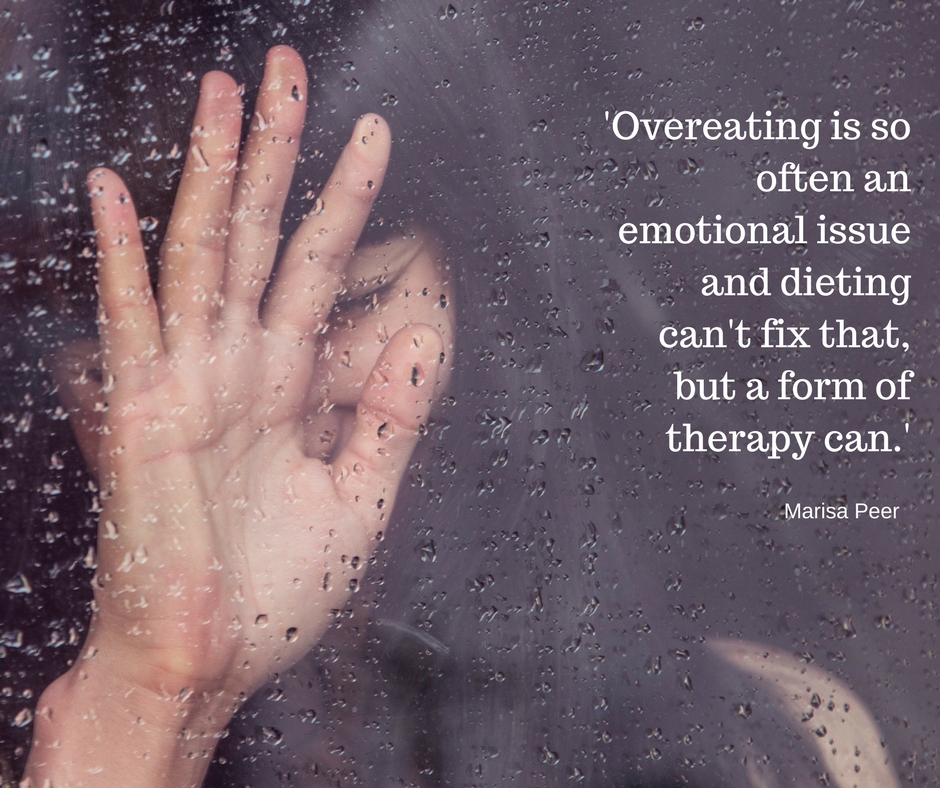
In her book You Can Be Thin, internationally renown hypnotherapist, Marisa Peer, identifies the six types of over-eater.

DeanaMorrisTherapiesTAFB

Let’s see which of these categories resonate with you.

Emotional Eater

Do you eat when you’re sad? Do you eat when you’re bored or when you’re lonely or feeling stressed?
Do you stand in the supermarket aisle agonising over which biscuits to buy your colleagues/friends/family?
Do you believe certain comfort foods make you feel better?
Do you eat differently when you’re with other people than when you’re on your own?

Addictive Eater

Do you crave sugar and go on sweet-stuff binges? Like not so much one biscuit, but a packet?
Or are you a crispoholic who can cheerfully demolish a large bag of crisps.
Do you eat sensibly all day and then lose control in the evenings?
Do you eat foods like crisps or chocolate so fast you realise you’ve eaten far more than you meant to and you don’t even remember enjoying it?

DeanaMorrisTherapiesTh

Habitual Eater

Are you a member of the clean plate club – you just can’t leave food even if you’re full.
Do you find it hard to throw food away?
Have you lost touch with being able to recognise when you’re full and when you’re hungry?
Do you eat what’s in front of you whether or not you’re really hungry?

Misinformed Eater

Do you think a glass of orange juice, granola and milk is a healthy breakfast choice?
Do you count potatoes as one of your five-plus fruit and veg portions?
Do you think low-fat foods and diet drinks help you lose weight?
Would you class dairy, bread and cereals as good foods?

Destructive Eater

Do you get close to your ideal weight and then sabotage your best efforts?
Do you feel anxious and uncomfortable when you’re slimmer?
Do you feel uneasy when your body is on show and prefer to layer up?
Do you like bigger clothes and prefer winter clothes to summer?

Angry Eater

Do you prefer crunchy, chewy food – crisps and French bread, nachos and toffees?
Do you chew gum morning, noon and night?
Will you go eat after you’ve been arguing because it shifts your state of mind?
Do you get irritated when you have to wait for your food – for example, when you’re on an aeroplane?

Worked out which of the six apply to you?

Now if you hadn’t guessed, it’s the misinformed eaters who stand a good chance of getting long-term results with dieting alone, because they just need to change their food choices.

For those of us who understand it’s our emotions or habits, frequently stemming from our childhood, ways of eating that can have been ingrained over decades, then we have a different job on our hands.

LoseWeightwithDeanaTeeth

You see, your mind’s job is to move you away from pain and so it will do whatever it takes to keep those feel-good chemicals whirring about in your brain. If it thinks cakes make your happy, when you’ve had a bad day, you’ll find yourself thinking about cakes – because your mind wants you to cheer up. Maybe you think about a particular cake that you associate with good friends or fond memories… sound familiar?

Once you know what’s pushing your buttons then the task is to rewrite your habits. Hypnosis helps you work with your subconscious, where all these past behaviours originate.

Through hypnosis you can get the whole of the mind on board with what you want, so you’re not relying on willpower alone. You rewrite your habits and repeat your new thoughts until they because second nature habits.

It is possible to see food as just food. It really is. And I have to say, knowing that and feeling that tastes pretty good.


Letting in light

Letting in light

When you choose a profession that aims to improve people’s lives, you likely do so because you are a Giver. Or a Fixer. Or that hybrid, the Giver-Fixer.

I’ve been learning recently about how to ask for client feedback, but most importantly, to also let in the kind words I hear back. I love seeing people shine and I love solving problems. But hearing how much I help people and letting myself enjoy that kindness… not so much! I go all bashful and blush, because like a lot of women I was brought up to see taking any kind of pleasure in being praised as some sort of moral failing. Somewhere up there with being a first class show-off.

Virtue may be its own reward, but if I’m not sharing the success stories, how am I helping anyone? I’ve come to realise happy clients want to help others.

So in the spirit of letting in praise and sharing that, below is a testimonial from a client I saw for stopping smoking earlier this month.

Nothing to do with weight control, at first glance. But sometimes the things that weigh us down aren’t sitting on our stomach, or hips and thighs.

In someways they’re worse, because they sit on our shoulders until they ache. They keep us awake at night and they gnaw away at our self-confidence. Or they sit on our chest and weigh heavy on our hearts.

Sometimes ‘feeling lighter’ is a metaphor. But it is possible to lighten your load and let go of that millstone.

And letting in praise does light you up. Remember to take your bows. And even nip back for one or two curtain calls. Smiling and breathing it in.

SmokingTestimonialDMT


5 Easy Steps to enjoying Christmas parties without piling on pounds

5 Easy Steps to enjoying Christmas parties without piling on pounds

Xmaspartyfood

1. When you’re the party queen, buy some food you don’t like!

Right, the emotional eaters are now freaking out, but this does make sense… If emotions trigger your over-eating I’m willing to bet you show love with food. It’s second nature for you. You want to show everyone how much you care so you choose your favourites, or certainly flavours you relate to, even at a subconscious level. Your childhood favourites, perhaps?

Yes, you make sure there’s plenty of the good stuff you like, different salads and lean meats to choose from.

But if you struggle to stop eating crisps once you start, buy crisps in flavours you don’t like — the kids aren’t going to care. Pick up the biscuits that you’re not a fan of. No one is going to judge you for not having triple chocolate chip, fairy dust and unicorn breath cup cakes on hand at every turn. (yes, I made that up. They are not a thing!) If you don’t like mince pies, there you go.

FoodXmas

2. Use smaller plates

When your plate is smaller you can pile it up and it looks like you’ve got loads of food, so the mind is automatically satisfied you’ve eaten plenty.

3. Run towards the salad

If you eat lots of veg you’ll aid your digestion, and you’ll be full of good stuff. So yes, eat it first and then savour the your favourite treats. You’ll feel energised instead of stodgy.

4. Eat before the event

This tactic ensures you body gets proper nutrition and you can then pick at the party food. No one is going to be offended that you don’t hoover up everything in sight. No one will notice.

5. Hang out with the health food friend

See the friend heading for the salad. Run! Run towards her and eat with her. When you look at her plate it will look like yours so you won’t get what I call FFFOMO (Fat Food Fear of Missing Out) and you’ll be mirroring her behaviour, so you won’t start to feel awkward. Eat with your pal who lives on chocolate and chips and looks like a piece of string (we all know one, don’t we?) and you’ll start anticipating what she might be thinking about what’s on your plate and you’ll feel this urge to be like her and eat crap.

And if all else fails…

It’s the morning after… maybe even the afternoon after… you wake up  with the mother of all hangovers and start flash-backing to cheeseboard carnage. Then you remember washing it down with three bowls of Aunty Nelly’s sherry triple. Don’t give yourself a hard time. Don’t do that, ’oh, I may as well be hung for a sheep as a lamb’ thing and go on a sugar bender until January.

We all fall over. We all trip up. When you learned to walk, how many times did you fall on your bum before you got the hang of it? You laughed, didn’t you. You got up and you kept going until you could walk with confidence. You didn’t throw your hands in the air and scream ‘That’s it, I’m over this walking thing. I’m sitting here til the day I die.’ You laughed, got up and tried again. Eating right is just like that.

So no catastrophising. If Christmas is about love, joy and peace, that includes you too. Have an amazing time this festive season. Love to all.

Delicious yoga for real food superstars

Delicious yoga for real food superstars

I’m thrilled to announce I’m working with Real Food Wythenshawe, delivering yoga classes for this fabulous organisation over the next couple of months.

Real Food Wythenshawe is an ambitious five-year programme, bringing a passion for growing and cooking fresh, sustainable food to the people of Wythenshawe. There’s a plateful of projects, from a Geodome at the back of Manchester College to growing fruit and veg in Wythenshawe Park to running a real food demo kitchen and supporting a food bank.

At the heart of the mission is enabling a community to lead healthier, lower carbon lifestyles through the food they grow, cook and eat.

I come in on the ‘healthier’ assignment and I’ll be delivering yoga that is nourishing in its own way.

Real food, food that grows and is fresh and is full of nourishing energy is central to Deana Morris Therapies’ values so it’s a great fit for me as I’m forever demonstrating to clients how junk food actually robs us of energy.

Preparing these yoga classes, I’ve been thinking about how dramatically our food choices have changed over the past 30 years. Growing up, our family had an allotment and we also grew fruit and veg in our garden as well as in a cold frame, which was cunningly crafted from two old windows and some wood. Any other supplies came from a fruit and veg shop at the bottom of the road. Although, I might add, my dad worked at a local factory that made something laughably called Angel Delight. I was no stranger to powdered puddings (Butterscotch flavour anyone? Yeah, thought not). But at least there was some balance between super-fresh and super-processed convenience food.

Today it feels supermarkets have taken over feeding us. Your choices may be ‘fresh’ but how fresh is anything that’s wrapped in plastic and will be past its use-by date in two days’ time?

At home we’ve recently started having a weekly organic veg and meat box delivered, which has been changing how we appreciate food as well as how much we spend. We actually spend a little bit less than we used to in the supermarket shops, which surprised me, but that’s possibly because we throw away less. For a start, most of the vegetables keep in the fridge for up to two weeks. They’re clearly grown for flavour, they’re not full of water and my partner now thinks I’m a great cook as well. But it’s just nutrient, flavour-dense, fresh food doing all the work. With a little help from me, of course.

And it’s great to discover there’s a grassroots real food project out there locally, spreading the word, and the appetite for fresh-out-the-ground fruit and veg.

Right, that’s my food and eating pun quota done for the day. But if you’ve any thoughts on how we can get more of us eating super-fresh, I’d love to hear your comments. Maybe it’s not just a problem for us urbanites. Is it just as much a problem out there in the countryside? Do feed back… ooh, another pun!